
By Andreas Wocke | RiseOfMind.com
Anyone setting up a branch in India or looking to integrate Indian professionals into their company will quickly realise that the real work only begins once the contract has been signed. Recruitment, loyalty, employment law and salary expectations – all these operate according to different rules in India than in Germany. Some of them are surprising to us, others are quite understandable once you know the context. And then there is the issue that has particularly challenged us time and again in recent years: what happens when an Indian colleague is due to come to Germany?
A labour market of contrasts
India presents a paradox that one should be aware of before considering recruitment: the country produces more university graduates than almost any other nation in the world – and yet there is a significant shortage of skilled workers in certain sectors.
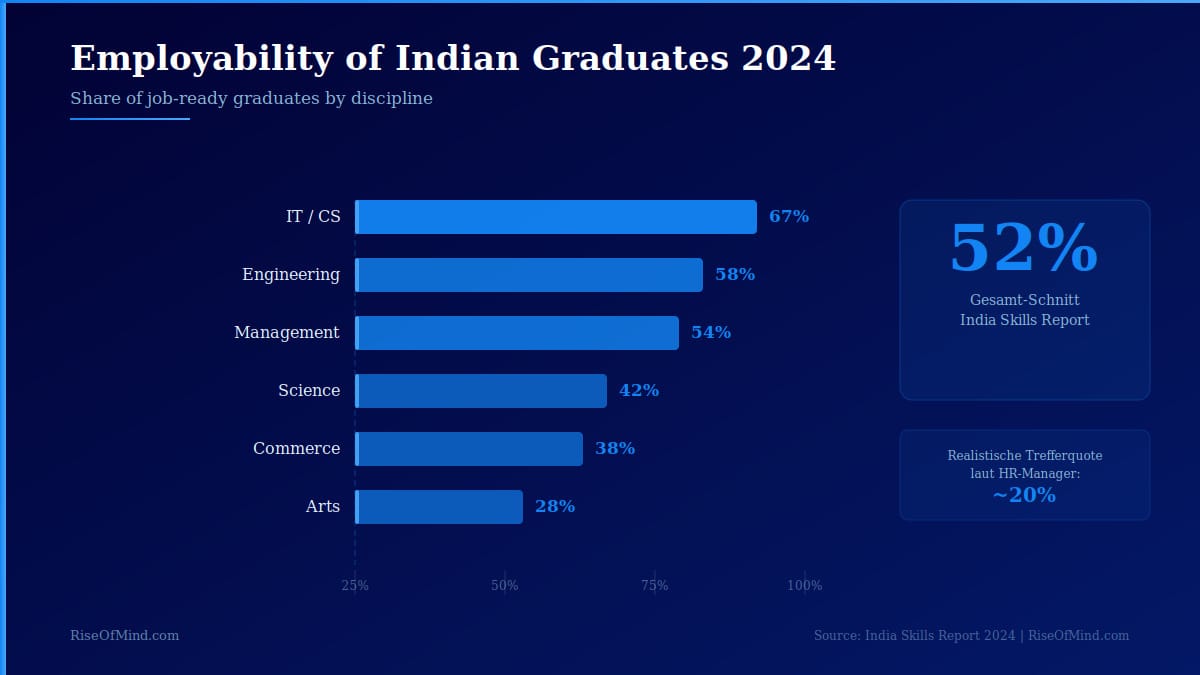
According to the India Employment Report 2024 by the International Labour Organisation (ILO), well-educated young people in India are significantly more likely to be unemployed than those without formal education. The unemployment rate among university graduates under the age of 30 stands at around 29%. At the same time, according to the India Skills Report 2024, only around 52% of university graduates are considered immediately employable – measured against the actual requirements of industry. When speaking to local HR managers, the picture becomes even bleaker: in their estimation, realistically suitable candidates often account for only around 20% of all applicants.
The apparent contradiction disappears as soon as one takes a closer look: whilst India produces an impressive number of university graduates, the quality behind this figure could hardly be more varied. The renowned Indian Institutes of Technology (IITs) and Indian Institutes of Management (IIMs) enjoy a global reputation and produce graduates who thrive immediately in the job market. However, there are also thousands of other institutions whose graduates are often ill-equipped to meet the real demands of the business world – well-educated on paper, but ill-prepared for practical work.
For European companies, this means: the potential is real and vast. But the recruitment effort is considerable – and a cover letter alone says little. Finding, assessing and retaining good candidates takes time, structure and patience.
Recruitment: What you really need to look out for
Anyone recruiting in India for the first time will be inundated with applications. That sounds good at first – 1,000 or more applications for a single role are not uncommon. The challenge lies in the screening process.
CVs in India are often long, formal and – to put it bluntly – heavily embellished. Experience is exaggerated; projects in which one was only marginally involved are described as personal achievements. This is not a question of integrity, but of a culture in which the first impression on paper plays a decisive role. A robust process is therefore required: technical tests, technical interviews, and ideally a trial period. Obtaining references is useful, but it also provides a distorted picture – social conflicts are rarely played out openly in India.
This presents a challenge one might not expect: even if the documents look promising, you first have to find out in a face-to-face interview whether the person sitting in front of you really matches what is on paper.
It happens more often than you might think that the two have little to do with one another.
What is reliable, however, are direct recommendations from your own network. Indian employees readily recommend colleagues, fellow students or relatives. This can be an enormous advantage – if you have a good employee who fits well into the team, you can quickly find other strong candidates through them. The downside of this practice is well known: networks can emerge that are more loyal to one another than to the company.
A phenomenon that has noticeably increased in recent years is so-called no-shows: you’ve finally found the right candidate, signed the employment contract – and then they simply don’t turn up. Instead, they use the offer on the table as leverage to negotiate even better terms with other companies. Therefore: Signing the contract is not enough – stay on top of it until the new colleague actually turns up on their first day of work.
Loyalty: What it is and what it isn’t
Hardly any topic is as frequently misunderstood by European companies when working with India as loyalty. My impression after many years: Indian colleagues are often exceptionally loyal – but in a different way than we ‘Westerners’ expect.
In India – and this is not a purely Indian phenomenon – loyalty often applies first and foremost to the relationship with the immediate superior or mentor, and only secondarily to the company as an institution. This means that those who build a strong, respectful relationship – who listen, acknowledge and offer prospects for development – often receive a sense of loyalty in return that goes far beyond what is contractually required. Those who do not do this will find that even the most generous pay rise will not permanently stop staff turnover.
At the same time, changing jobs is far more socially accepted in India than in Germany. Changing employers every two to three years is no exception in the IT sector – it is, in fact, the norm. The main driver is almost always salary: Those who move on usually receive 10 to 20% more. Those who stay receive the standard annual increase of five to ten per cent. This creates a structural incentive for staff turnover, which can only be countered with targeted measures – through development reviews, promotions, clear career paths, project-based bonuses and a corporate culture in which employees feel valued.
Moonlighting: The open secret
A phenomenon that almost inevitably becomes an issue at some point in European companies with Indian teams: moonlighting – working for several employers simultaneously, often without the main employer’s knowledge.
In the wake of the coronavirus pandemic and the associated rise in remote working, moonlighting has increased significantly in the Indian IT sector. According to an analysis by recruitment firm Randstad, moonlighting activity rose by up to 30% within three years. The reason is a simple economic calculation: many well-qualified developers feel their salary is not commensurate with the work they do – and use their spare capacity for project-based work via platforms such as Upwork or Fiverr, or simply for a second permanent employer.
In the Indian IT industry, the debate on this issue has been conducted openly. Wipro, one of the country’s largest IT companies, dismissed 300 employees in 2022 for working simultaneously for rival firms, describing this as a simple breach of contract. Infosys, on the other hand, has since introduced a model that permits gig work subject to prior approval from management.
Legally, the situation in India is inconsistent: there is no national law explicitly prohibiting moonlighting. In the IT sector – which is not covered by the Factories Act of 1948, which generally prohibits dual employment in industry – the assessment depends almost entirely on the employment contract. If it contains an exclusivity clause, moonlighting constitutes a breach of contract. If it does not, it is formally permissible.
The current rate in the IT sector, following the easing of the work-from-home trend, is estimated at 1 to 2% of employees in larger companies that carry out regular checks – in reality, the number of unreported cases is likely to be higher. For Western companies with links to India, the following applies: clear contractual clauses are essential. And: Anyone seeking an honest answer to the question of why an employee is moonlighting should first provide an honest answer to the question of whether the salary and working conditions are in line with the market.
Salary and non-wage labour costs: What an employee really costs
One of the most common misconceptions is the assumption that Indian skilled workers are permanently cheap. This is partly true – but salaries in the Bengaluru IT sector have risen by double-digit percentages annually in recent years. According to Glassdoor and PayScale, a software developer with three to five years’ experience now earns a median gross annual salary of INR 8 to 12 lakh (approx. €8,800–13,200 gross), whilst a senior role can easily reach INR 15–25 lakh. This is still considerably cheaper than in Germany – but significantly more expensive than it was just five years ago.
| Experience Level | Annual Base Salary | EUR |
|---|---|---|
| Entry-level (0–2 years) | 3–5 lakh | €3,300–5,500 |
| Mid-level (3–5 years) | 8–12 lakh | €8,800–13,200 |
| Senior (6–10 years) | 15–25 lakh | €16,500–27,500 |
| Specialist / Tech Lead | 25–40 lakh+ | €27,500–44,000+ |
Benchmarks for the Bengaluru IT sector 2024/2025, sources: Glassdoor, PayScale
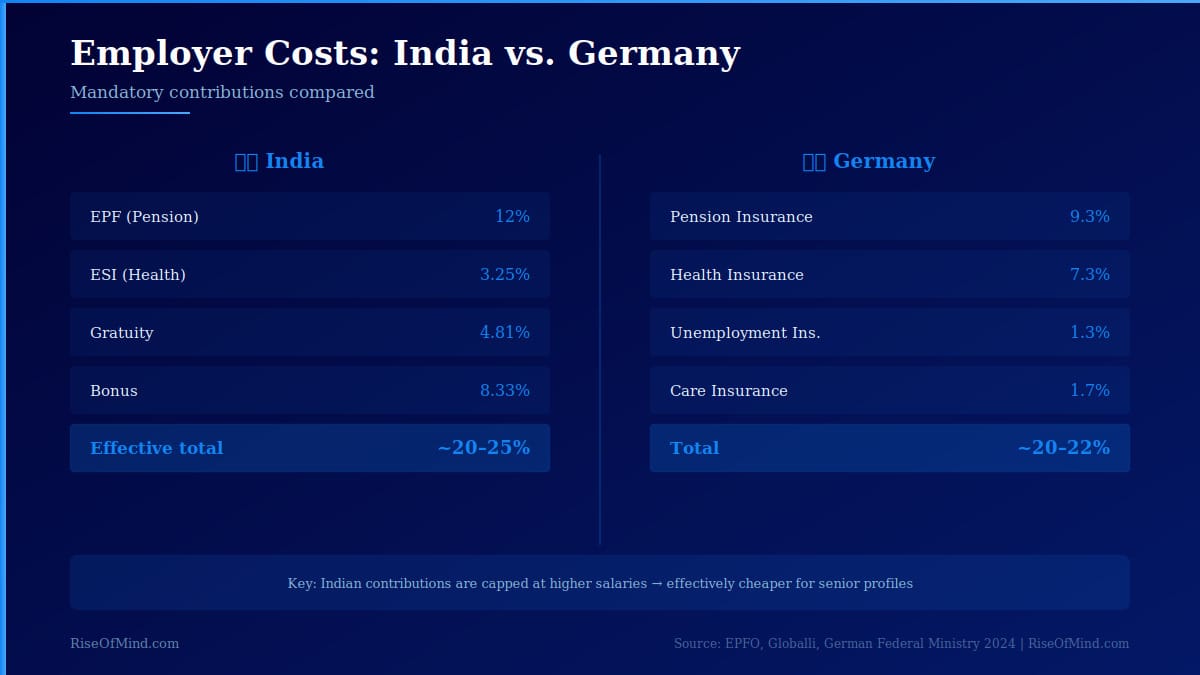
Mandatory deductions are added to the gross salary, which should be factored in from the outset. The most important ones on the employer’s side: EPF (pension insurance, 12% of basic salary, capped), ESI (health insurance, 3.25% – applies only to salaries up to INR 21,000/month, so usually not relevant for IT professionals), Gratuity provision (approx. 4.81% – payable after five years’ service) and a statutory mandatory bonus of at least 8.33% for employees below a certain income threshold.
In total, this amounts to a 20–25% surcharge on the basic salary for employers – a figure that, at first glance, is surprisingly close to that in Germany (~20–22%). The key difference: German social security contributions are levied on the full gross salary without any cap, whereas in India, contribution obligations for high-earning IT professionals apply only proportionally due to various income ceilings. For a senior team in Bangalore, this results in a more favourable overall picture than the percentage comparison initially suggests.
Incidentally, there is a figure in India that does not exist in Germany in this form: CTC – meaning CostToCompany. This includes everything, including the employer’s contributions.
Labour law: More complex than expected
Indian labour law has a reputation that is misunderstood in both directions. On the one hand, many believe India is very flexible for employers – you can dismiss staff whenever you want, there are no strong trade unions, and no protection against unfair dismissal. This is largely true for the IT sector, but certainly not without exception.
In fact, India and Germany share an unexpected characteristic when it comes to labour law: both countries have extremely extensive and complex regulatory frameworks. India has around 45 national labour laws as well as 200 additional state regulations, which may vary depending on the state. For a German company operating a branch in Karnataka (i.e. Bengaluru), Telangana or Maharashtra, different regulations may apply in some cases – regarding minimum wages, notice periods and compulsory contributions.
Of particular relevance to foreign companies are:
The right to terminate employment: For employees in IT companies – who are generally not ‘workmen’ within the meaning of the Factories Act – ordinary termination in compliance with the contractually agreed notice period is usually possible. One to three months is standard. For operational staff in companies with more than 100 employees, depending on the state, approval from the relevant Ministry of Labour is required.
The Gratuity Act: Anyone who has been with the company for at least five years is entitled to the severance payment described above upon leaving. This may sound like a manageable amount, but it can be significant for long-serving executives – and should be provisioned for from the outset.
In short: anyone operating a subsidiary in India needs a reliable local HR partner or a specialist law firm. The matter is too complex to manage on the side.
Bringing Indian colleagues to Germany: what that really means
It sounds like a matter of course: a developer from your own Bengaluru team is to come to Germany for a few months, get to know the local team, drive forward an important project – and later, back in India, build a bridge between the cultures. In practice, this marks the start of a process that can easily take a year – and which brings home the bureaucratic limitations of Germany as a business location very directly.
First, the good news: the situation has improved noticeably in recent years. As part of the German-Indian ‘Focus on India’ programme, several simplifications were introduced in 2024. Visas for Indian skilled workers are now processed entirely digitally in some cases, and the processing time under the standard procedure is said to have fallen to around two weeks – a significant improvement on the four to nine months that used to be the norm.
Furthermore, the number of Indians working in Germany has risen from 23,000 in 2015 to over 137,000 in 2024 – a sign that the bridge works, provided it is used correctly.
The reality on the ground is often more nuanced. For a secondment within an existing corporate structure, the ICT Card (Intra-Corporate Transfer) is the right tool. It enables managers, specialists and trainees to work temporarily at a German branch. Requirements: a proven university degree, an existing employment relationship with the sending company of at least six months, and a corresponding secondment contract.
For permanent employment in Germany, the EU Blue Card is the appropriate option. The requirements are a university degree and an employment contract with a minimum gross annual salary of 45,934 euros for IT shortage occupations (as of 2026) or 58,400 euros in all other occupational fields. That sounds like a clear rule – and formally, it is. In practice, however, this is where the real work begins.
This is because Indian university degrees generally need to be recognised in Germany. This is done via the Anabin database and, where necessary, the relevant recognition authority. Depending on the circumstances, recognition takes three to four months – ideally, you should start this process before beginning your visa application. No visa without recognised qualifications, no start without a visa.
Added to this are certified translations of documents into German, the signing of a German employment contract before entry, registration with the Residents’ Registration Office upon arrival, and the application for the Blue Card at the Foreigners’ Registration Office. And that’s just the bureaucratic part. What’s easily overlooked alongside this: finding accommodation, transport, health insurance, school places for children, flights home – all of this needs to be organised, supported and often financially backed. Anyone who tells an Indian colleague, “You’ll be coming to Germany in two months”, has most likely been too optimistic in their planning. You quickly learn that this is a proper project in its own right – with its own budget, its own timetable and someone to coordinate it.
My practical advice: start early, involve a specialist service provider and set realistic expectations for everyone involved right from the start.
What comes next?
The third and final part of this series looks at the bigger picture: India’s demographics compared to China, the role of AI for the subcontinent, customs and import restrictions for businesses, and a personal assessment – what makes India a significant long-term partner for European companies, and where do the real limits of cooperation lie?
References
- ILO India Employment Report 2024 – Graduate Unemployment ILO report showing that higher education in India paradoxically increases the risk of unemployment among young people.
- India Skills Report 2024 – Wheebox / Employability of Graduates Data on the employability of Indian university graduates from 2014–2024, based on the annual India Skills Report.
- CNBC – Moonlighting in India's IT Sector (July 2023) Feature report on the growing prevalence of moonlighting in India's IT sector despite employer resistance.
- Times of India / AuthBridge – Moonlighting Trends IT Sector 2024 Study on rising moonlighting cases in the IT sector, based on background check data from AuthBridge.
- Glassdoor – Software Developer Salaries Bangalore 2024/2025 Salary overview for software developers in Bangalore based on anonymous user data (page may require login).
- PayScale – Software Developer Salary Bangalore 2025 Current salary data for software developers in Bangalore including median and percentile values.
- EPFO – Contribution Rates EPF / EPS / EDLI Official EPFO document detailing the applicable contribution rates for EPF, EPS and EDLI (employee and employer shares).
- ClearTax – ESI Rate 2024-25 Overview of current ESI contribution rates for employers and employees in India.
- Globalli – Employer Costs in India (incl. EPF, ESI, Gratuity) Practical article on the full scope of employer costs in India, including mandatory contributions and statutory gratuity.
- Wikipedia – Indian Labour Law Overview Overview of Indian labour law: key legislation, regulations on minimum wage, protection against dismissal and social benefits.
- Make it in Germany – EU Blue Card (Official Federal Government Page) Official German government information page on the EU Blue Card as a residence and work permit for skilled professionals.
- Make it in Germany – ICT Card Explanation of the ICT Card for the intra-company transfer of executives and specialists to Germany.
- Jobbatical – Germany-India Skilled Workers Agreement, Focus on India (2024) Practical guide to relocating Indian skilled workers to Germany, covering the process, timelines and challenges.
- Die-Indien-Beratung – Visa Requirements for Indian IT Professionals (Dec. 2024) Detailed visa requirements and employer obligations when recruiting and transferring Indian IT professionals to Germany.
About the Author